Can Early Loss of Baby Teeth Cause Speech Problems in Children?
Posted on 3/10/2026 by NC Pediatric Dentistry |
 When a child loses a baby tooth earlier than expected, parents often wonder whether it could affect their speech development. It’s a fair question. Baby teeth play a bigger role in how children form sounds than most people realize, and losing certain teeth too soon can temporarily change the way a child speaks. For families across North Carolina, understanding when early tooth loss is just a cosmetic concern and when it could affect development helps take some of the guesswork out of the situation. When a child loses a baby tooth earlier than expected, parents often wonder whether it could affect their speech development. It’s a fair question. Baby teeth play a bigger role in how children form sounds than most people realize, and losing certain teeth too soon can temporarily change the way a child speaks. For families across North Carolina, understanding when early tooth loss is just a cosmetic concern and when it could affect development helps take some of the guesswork out of the situation.
This post explains how baby teeth contribute to speech, which teeth matter most, and what options like space maintainers can do to protect your child’s dental development after an early loss.
On This Page
Why Baby Teeth Matter for Speech Development
Children start forming speech sounds well before their permanent teeth arrive, and baby teeth serve as the physical landmarks the tongue and lips use to produce those sounds. The upper front teeth, for instance, are essential for sounds like “f,” “v,” and “th.” The tongue presses against or near these teeth to create the right airflow and vibration.
The “s” and “z” sounds rely on the tongue positioning itself just behind the upper front teeth. The “t,” “d,” and “n” sounds require contact between the tongue tip and the ridge right behind the upper incisors. When those teeth are present, the child’s mouth has a stable framework for learning and practicing speech. When they’re missing too early, that framework changes.
It’s worth noting that not every baby tooth matters equally for speech. The front teeth (incisors) tend to have the most impact because so many consonant sounds depend on them. Back molars, while critical for chewing and spacing, don’t influence speech production as directly.
How Early Tooth Loss Can Affect the Way Your Child Speaks
 When baby teeth are lost on schedule, the permanent teeth are usually close behind, and any speech disruption is brief. But when a tooth is lost well ahead of schedule, whether from decay, injury, or extraction, the gap can persist for months or even years before the permanent tooth is ready. When baby teeth are lost on schedule, the permanent teeth are usually close behind, and any speech disruption is brief. But when a tooth is lost well ahead of schedule, whether from decay, injury, or extraction, the gap can persist for months or even years before the permanent tooth is ready.
During that time, some children develop a lisp or have trouble with certain sounds. The tongue may push into the empty space instead of pressing against the tooth, changing how air flows during speech. In our experience, kids are remarkably adaptable; many adjust on their own within a few weeks. But when multiple front teeth are missing, or when the loss happens at a young age (before 4 or 5), the speech effects can be more noticeable.
The emotional side matters too. Children who are self-conscious about a gap or a lisp may speak less, mumble, or avoid participating in class. Addressing both the physical and emotional aspects helps a child feel more confident.
Beyond speech, early tooth loss creates a spacing issue. Neighboring teeth can drift into the gap, crowding out the permanent tooth and creating alignment problems that might otherwise have been avoided. This is where a space maintainer comes in.
How Space Maintainers Protect Your Child’s Development
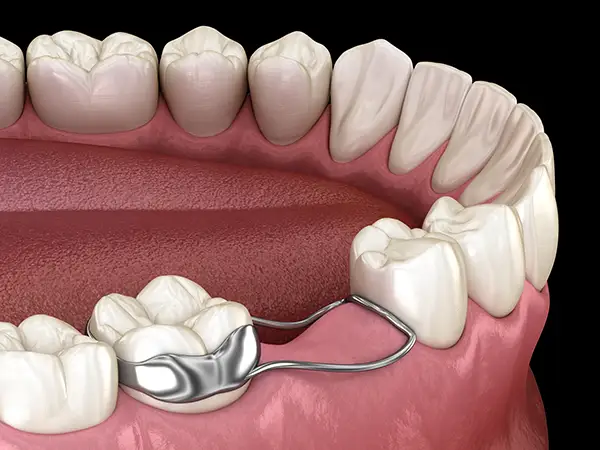
A space maintainer is a small dental appliance, usually made of metal, that holds the gap open after a baby tooth is lost early. It prevents the surrounding teeth from shifting into the space, so the permanent tooth has room to come in where it’s supposed to.
Space maintainers don’t replace the missing tooth visually, so they won’t directly resolve a speech issue caused by a missing front tooth. But they do protect long-term alignment, which supports healthy pediatric dental development overall. In some cases, your dentist may discuss a temporary cosmetic option for a missing front tooth if speech or self-confidence is a concern.
The appliance is fitted in a single appointment, and most children adjust to it within a day or two. It stays in place until the permanent tooth is ready to erupt, at which point it’s removed.
Supporting Your Child Through Early Tooth Loss
If your child has lost a baby tooth early and you’re noticing speech changes, a visit to your pediatric dentist is the best starting point. Our team at NC Pediatric Dentistry can evaluate the gap, discuss whether a space maintainer is appropriate, and help you decide if a referral to a speech-language pathologist would be helpful. We have offices across North Carolina ready to help. Visit our locations page to find an office near you and schedule an appointment.
Frequently Asked Questions
Will my child’s speech go back to normal once the permanent tooth comes in?
In most cases, yes. Once the permanent tooth erupts and fills the gap, children typically readjust their speech patterns quickly. If a lisp or sound error persists, a speech-language pathologist can help with targeted exercises.
Which baby teeth are most important for speech?
The upper front teeth (incisors) play the biggest role in speech. Sounds like “f,” “v,” “th,” “s,” and “z” all depend on tongue and lip contact with or near these teeth. Back teeth are less directly involved in speech production.
Does my child need a space maintainer for every lost baby tooth?
Not always. Your pediatric dentist will consider which tooth was lost, how soon the permanent tooth is expected, and whether surrounding teeth are likely to shift. Front teeth that are close to natural shedding age may not require a maintainer.
Can a dentist tell if early tooth loss is affecting my child’s speech?
A pediatric dentist can assess the physical impact of the missing tooth and identify whether it’s likely affecting speech. For a full evaluation of speech development, a referral to a speech-language pathologist may be recommended alongside dental treatment.
How can I help my child feel less self-conscious about a missing tooth?
Normalize the experience. Remind your child that losing teeth is a natural part of growing up, even if theirs happened a little earlier. Praise their bravery, answer their questions honestly, and let them know the permanent tooth is on its way.
|
|